Beneath the Swarm: An Immersive Underwater Meditation

// services
Interactive Installation
Experiential Design
Real-Time Visuals
Immersive generative installation placing visitors inside a living simulation of marine life. Swarm behaviour algorithms drive fish, turtles, jellyfish, and whales that respond to human presence.
Marine life as a living algorithm
Beneath the Swarm started from a single question: what does it feel like to be inside the ocean rather than looking at it through glass? The installation places visitors inside a generative simulation of marine life, fish, turtles, jellyfish, and whales, rendered as fluid digital entities governed by swarm behaviour algorithms.Each creature type follows its own rule set. Fish school. Jellyfish drift. Whales move through the space with a different weight and intention. Together they create an ecosystem that looks organic because the underlying logic is organic, drawn from decades of research into collective animal behaviour. The simulation runs in real time. No two moments are identical.

Presence as an input
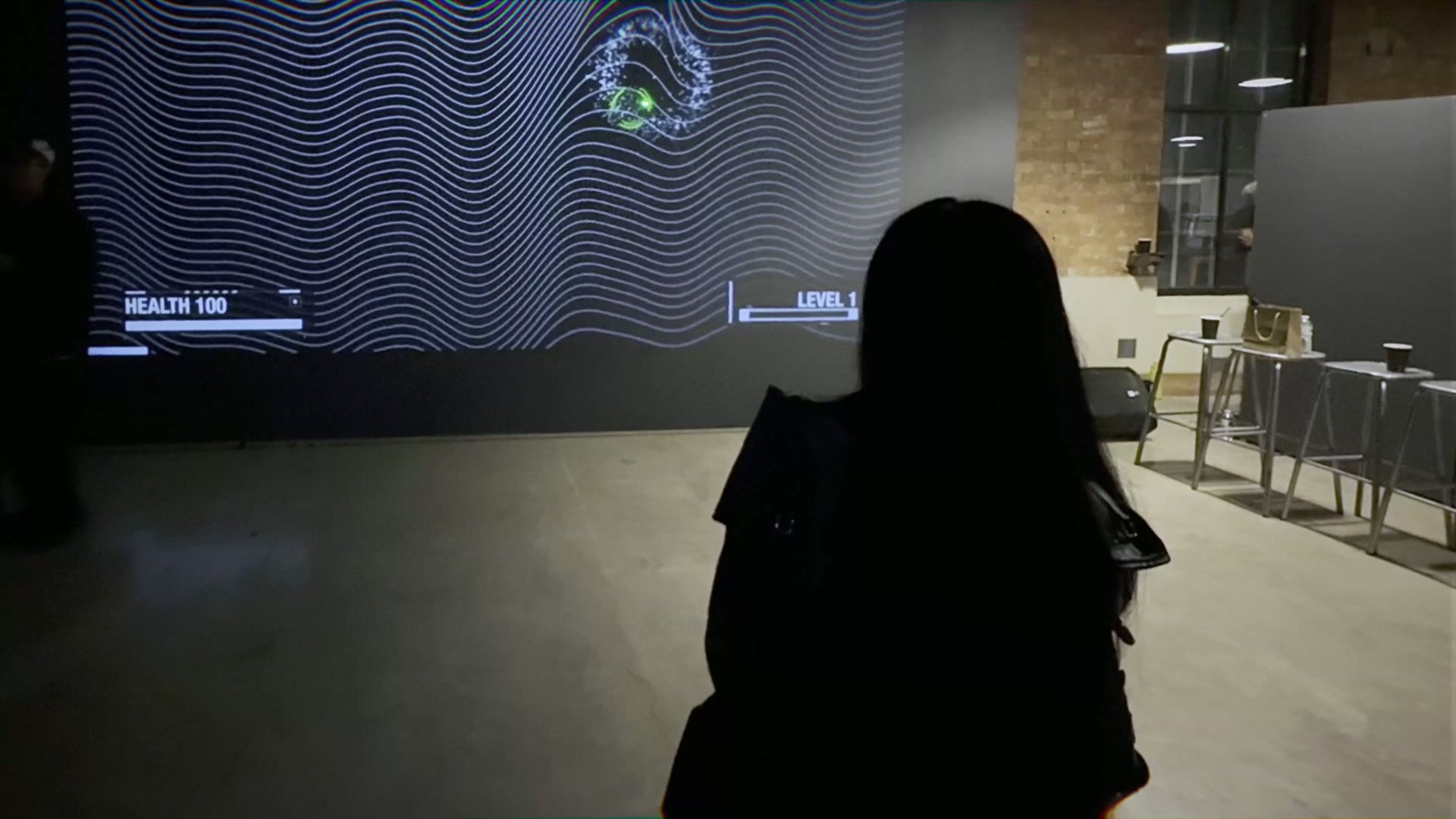
The installation is reactive. Sensor data from the gallery space feeds directly into the simulation, and the creatures respond to the presence and movement of visitors. Walk toward a school of fish and they scatter. Stand still long enough and a whale may drift closer.This is not a gesture interface in the conventional sense. There are no prompts, no instructions, no correct way to interact. The reactivity is ambient, something you notice gradually rather than something you are told to look for. The technical challenge was making the reactivity feel natural rather than mechanical. Response thresholds, latency, and the translation between sensor input and simulation behaviour all had to be tuned carefully so the creatures felt alive rather than scripted.
Scaling for venue installation
Beneath the Swarm was built to work across different venue configurations, from single-screen gallery contexts to fully immersive multi-surface environments. The rendering pipeline scales without architectural changes, which makes the work genuinely touring-ready.Audio design plays an equal role to the visuals. The soundscape is generated in parallel with the simulation, so the acoustic environment shifts as the creatures move. In a fully enclosed space this creates a convincing sense of submersion. For venues and curators, the installation offers something that film-based work cannot: every performance is different, which means return visitors have a genuine reason to come back.