February was a quieter month than January. No tectonic releases, but a useful pile of smaller updates. Pose tracking got better. AI video got longer. Smart glasses got more honest about what they're for. Here's what's earned a spot in our toolkit.
Fifteen things worth your time this month
Immersive tech (AR, VR, XR)
1. NBA Tabletop Mode for Vision Pro
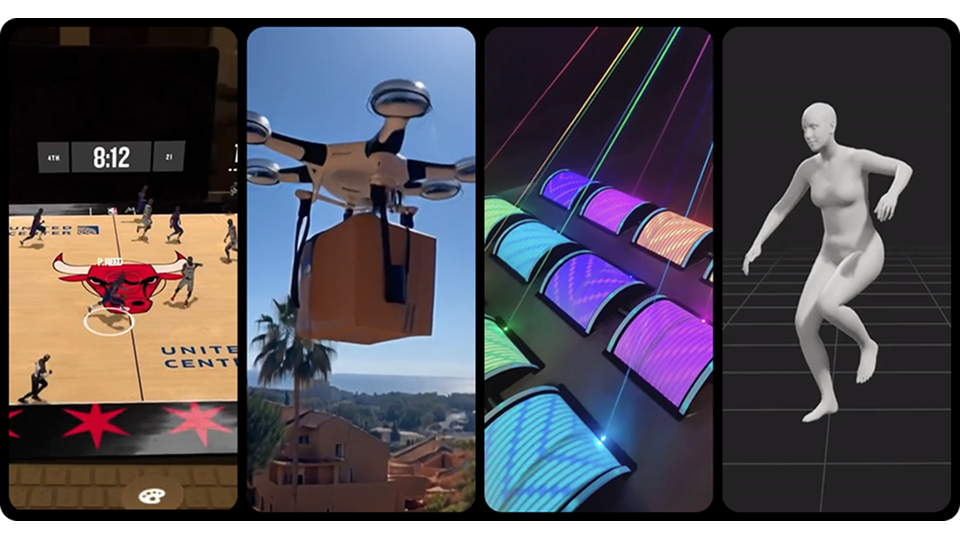
NBA League Pass now puts a live game on your coffee table. A tabletop AR view on Apple Vision Pro with real-time stats, alternate camera angles and overlays the user controls. It's the cleanest argument we've seen for why sports broadcasting and AR are about to share a lot of DNA. There's an obvious sponsor surface waiting in those overlays, and it's worth thinking about now if you have a sports brief on the horizon.
2. Capturing locations for AR exploration
A recent project showed a real-world location scanned, stitched and walked through in AR, detailed enough to make a portal-based experience feel like an actual place rather than a render. We've leaned on this technique on F1, where we scanned the Baku pit garage and built a portal that let users step inside. The barrier to bringing physical spaces into a digital activation is dropping fast, and that opens up tourism, event-preview and retail-portal briefs that wouldn't have penciled out a year ago.
3. Vuforia Engine 11
Vuforia's eleventh engine release sharpens object tracking, spatial navigation and cloud-backed AR. The headline isn't a single feature, it's reliability. The kind of upgrade that turns AR from a demo-floor trick into a deployable retail experience. Wayfinding, scavenger hunts, product demos, and guided tours are all suddenly more boring to build. That's a compliment.
Generative AI and content creation
4. Pika AI's two big releases
Pika had a big month. Pika 2.2 added Pikaframes (keyframe-driven transitions of 1 to 10 seconds) and bumped output to 10-second 1080p clips. A separate update added real-time object and people insertion, dropping new elements into existing video without traditional VFX. Together they're the difference between AI video as a novelty and AI video as a production tool you'd actually use in a campaign.
5. FLORA, AI for shot planning
FLORA is a node-based AI canvas built specifically for filmmakers. It doesn't just generate visuals; it reads a story's structure and proposes shots that serve it. Worth watching for any team that wants AI in the storyboard phase without losing creative ownership of what gets shot.
6. Microsoft Muse, gameplay from a single image
Microsoft Muse generates entire gameplay sequences from one input image, trained on real multiplayer data. The interesting bit isn't the demo, it's what it implies for prototyping branded experiences in days rather than months. More on Muse.
Immersive tools and real-time interaction
7. TouchDesigner MediaPipe plugin
The latest MediaPipe plugin for TouchDesigner adds OpenPose rendering, which means real-time face and pose tracking that feeds straight into Stream Diffusion. For live events and interactive installations that's a meaningful step. AI visuals that respond to a body in the space, not a click on a screen.
8. Wemade × NVIDIA ACE — AI bosses
Wemade unveiled "Asterion," an AI-driven MMORPG boss that adapts to player behaviour using NVIDIA ACE. The same tech reads as a quietly useful tool for branded interactions: a digital ambassador that actually responds to who's standing in front of it instead of running a script.
Interactive installations and displays
9. Weaving Light Tapestry
A laser and projection installation that uses light as a structural medium rather than a finish. Layers, lattices and weaves of beam that read more like fabric than a light cue. A useful proof of how immersive a piece can feel when light is treated as material.
10. Muxwave's interactive LED gateway
The LANG UK stand built a walk-through LED gateway using Muxwave's flexible display tech. The point isn't the spec, it's the form factor. A display that bends into architecture is a different design tool than a flat wall, and the difference matters when you're designing for retail or trade-show footfall.
Hardware and tools
11. Meta Aria Gen 2
Meta's second-generation Aria research glasses pack RGB capture, 6DOF SLAM, eye tracking, microphones and biometric sensors into a wearable form factor. They're a research kit, not a consumer product. But every brief we've seen for glasses-based experiences this year suggests 2025 is the year the form factor stops being theoretical. More on Aria.
Research and development
12. Meta for Education
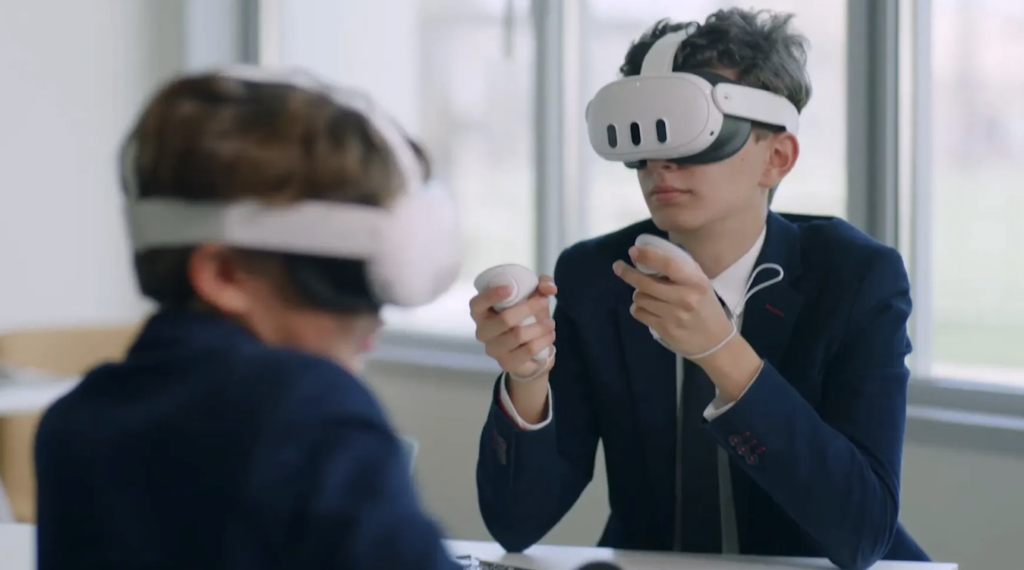
Meta is rolling Quest VR into schools and universities with device management and an immersive-app catalogue tuned for the classroom. Beyond education, the same toolkit reads as a strong fit for corporate training and collaborative workshops. More on Meta for Education.
13. 3D Gaussian Splatting for city simulation
Gaussian splatting is having a moment. Instead of building cities as polygons, it represents space as a cloud of point primitives. Light, fast and weirdly photorealistic. Pair it with Houdini and NVIDIA Cosmos and you can generate full cityscapes that hold up under interactive use. We see immediate use in driving sims and large-scale brand activations where the world has to scale.
14. Meshcapade MoCapade 1.0
Markerless motion capture from a single video at quality that previously required a suit and a stage. The accessibility shift is the whole story. High-fidelity motion data that fits inside a brief's budget instead of needing its own.
15. Niantic Scaniverse on Meta Quest
Scaniverse now does on-device photoreal 3D scanning with Gaussian splatting and exploration baked in. Walk around a place, scan it, walk through it again in VR. Useful for tourism, real estate and product showcases that need to feel like the thing they're selling.
What we're taking into March
If there's a thread running through this month's picks, it's that real-time is winning. Pose, motion, scene, voice and gameplay all moved an inch closer to "responds to you instantly," and that's where the next wave of interactive briefs is heading. Get in touch if any of this maps to something you're trying to build.